This newsletter is free and goes out to over 24,000 subscribers, but it’s only able to sustain itself due to the support I receive from a small percentage of regular readers. Would you please consider becoming one of those supporters? You can subscribe via Patreon or the Subscribe button below! You can also make one-time donations through Venmo or PayPal.
An anti-LGBTQ judge from Texas has been rewarded $640,000 for (1) refusing to do her job and (2) being Christian. It’s the culmination of a multi-year crusade by a conservative activist in a position of power.
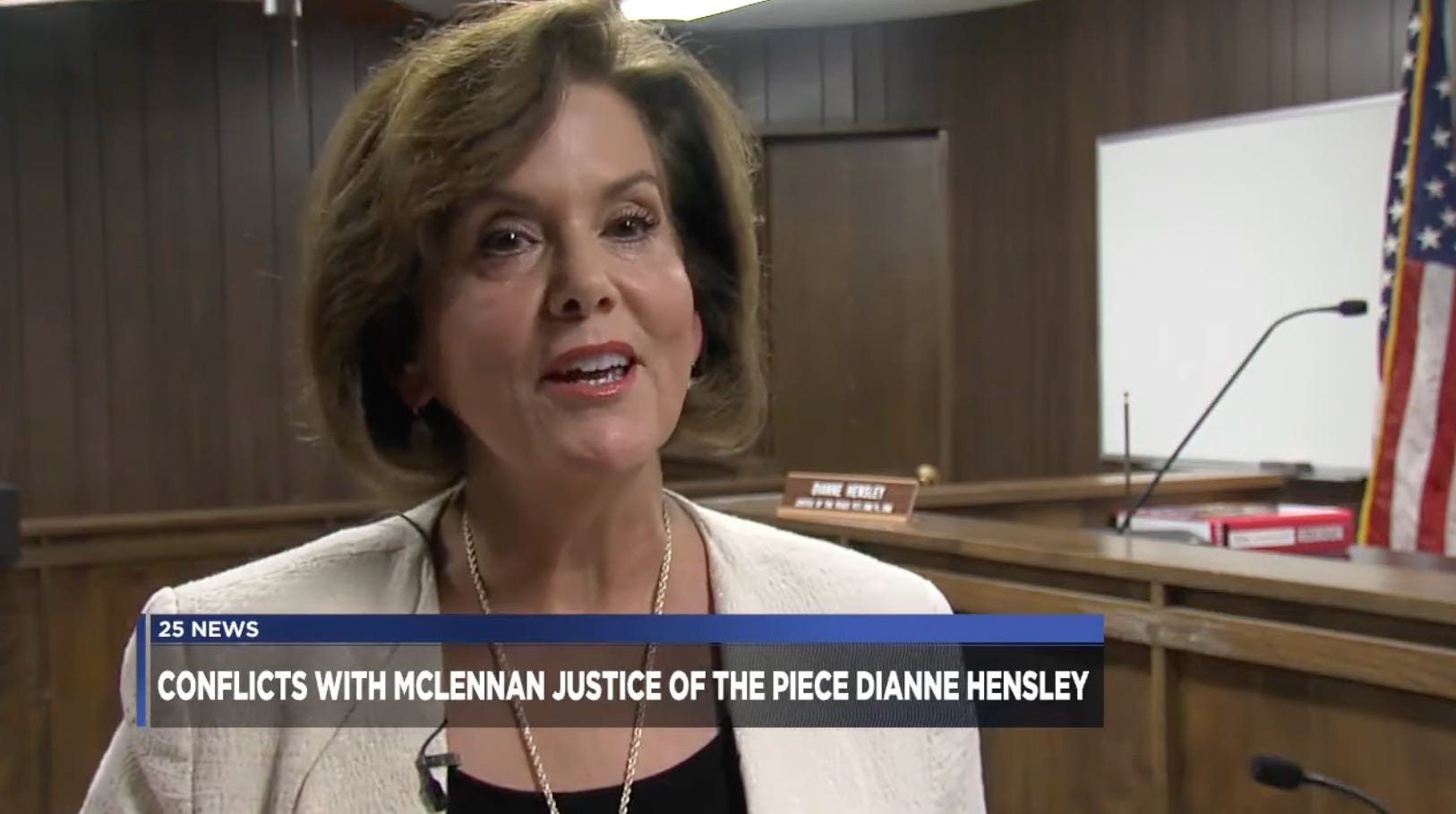
Back in December of 2019, Justice of The Peace Dianne Hensley refused to marry gay couples who visited her courthouse, even though she’s a public official and not a priest. She was given a public warning by the Texas Commission on Judicial Conduct… which was really nothing more than a slap on the wrist. Instead of removing her from the job she refused to do, though, the Commission merely said she was “casting doubt on her capacity to act impartially” and that she could be punished in the future.
In its lawsuit, First Liberty argues, “The Commission violated the Texas Religious Freedom Restoration Act by investigating and punishing Judge Hensley for recusing herself from officiating at same-sex weddings, in accordance with the commands of her Christian faith.” Adding, “By investigating and punishing her for acting in accordance with the commands of her Christian faith, the State of Texas has substantially burdened the free exercise of her religion, with no compelling justification.”
No “compelling justification”?! The compelling justification was that people deserve to be treated equally under the law. A judge who offered to perform wedding ceremonies for straight couples but not gay ones had no business being a judge. Being Christian shouldn’t allow government officials to ignore the law. It wasn’t okay when Kim Davis tried the stunt, and it shouldn’t have been okay with Hensley.
And “substantially burdened”?! In no way did the Commission impede on her rights.
She was asking for $10,000 in damages because that was the money she was losing by not being allowed to perform opposite-sex weddings. (Not performing any weddings was the only legal option she had at that point.) She also requested a declaration that everyone in her position could pull the same stunt if their God commanded it.
In 2021, a judge tossed out her case on technicalities, including the fact that the commission had sovereign immunity from such lawsuits. An appeals court later affirmed that ruling. But Hensley asked the state’s highest court to take up the case, and that’s what they did in 2023.
Her lawyer, Jonathan Mitchell—better known as the former state solicitor general behind Texas’ infamous abortion “bounty” law—argued that she had every right to discriminate on the basis of sexual orientation:
Mitchell further argued that state law protects people’s religious freedom unless there is a “furtherance of a compelling governmental interest.” He also said it prohibits wedding officiants from discriminating based on race, national origin or religion.
“Notably absent from that list of protected criteria that I just mentioned is any mention of discrimination on account of sex or sexual orientation,” Mitchell told justices. “It’s still permissible for wedding officiants — whether they’re judges or members of the clergy — to discriminate based on any other characteristic, as long as it’s not race, national origin or religion, when they decide which weddings they will officiate.”
Being a Christian, you see, allowed Hensley to be an anti-LGBTQ bigot, just not a racist one… even though both involve characteristics that people don’t choose for themselves.
The thing is: Hensley could have avoided this entire situation if she simply opted out of performing marriages and didn’t whine about it. No one was forcing her to perform that service. But she wanted the ability to get paid to sign marriage certificates for straight couples and not gay ones, and she believed her religion took priority over the law, even though she was working for the government. If we allow officials like her to pick and choose which rules to follow, it would throw the government into chaos. It would make a mockery out of civil rights.
As the commission’s lawyer explained, no one was punishing, or even threatening to punish, Hensley for her religious views. It was all about her actions. If a Christian judge made it clear that he didn’t want to perform any marriages because of his anti-gay bigotry, that would be just fine. Hensley, however, wanted to offer the service while excluding certain people. That was the problem.
(Side note: In an interview with The Dallas Morning Newsin late 2023, Hensley said she hadn’t performed any marriages in years. She also claimed, falsely, that children with opposite-sex parents fare better in life. Then there was this anecdote about her now-deceased gay (!) brother:
After he had a falling out with their parents over what she described as “economics,” Hensley said she hired a detective to track him down once a year and take a photograph as a gift for their mother. One year, he was in Paris. Another year in Japan. Then Dubai.
Creepy.)
In any case, if Hensley wanted to get ordained and perform private wedding ceremonies just for straight, white, evangelical couples, no one would be complaining. But she had no business discriminating against certain Texans when she was working for the government.
Her lawyers argued that the U.S. Supreme Court already sided with a Colorado website designer who refused to make wedding websites for gay couples (something no gay person actually asked her to do). But there was an obvious difference between a private business owner and a government official. Her own attorneys chose not to understand that difference.
The concern over what the Texas Supreme Court would do was very real. After all, if she won, what would stop other judges from using religion as an excuse to deny justice to other potential clients?
The Texas Supreme Court avoided her religious freedom argument, then the Texas Commission on Judicial Conduct dismissed its (already mild) sanctions on Hensley, then an appeals court said she could still proceed with her lawsuit… it was a hot mess with no end in sight. And while all that was happening, another bigoted Christian judge filed his own lawsuit for the same underlying reasons.
At some point, the Texas Supreme Court was going to have to make a decision.
Last year, they did just that. They issued an edict saying it was perfectly fine for judges to refuse to perform same-sex weddings if that conflicted with their personal religious beliefs. More importantly, that act of open bigotry wouldn’t be treated as evidence that those judges have any animosity against LGBTQ people.
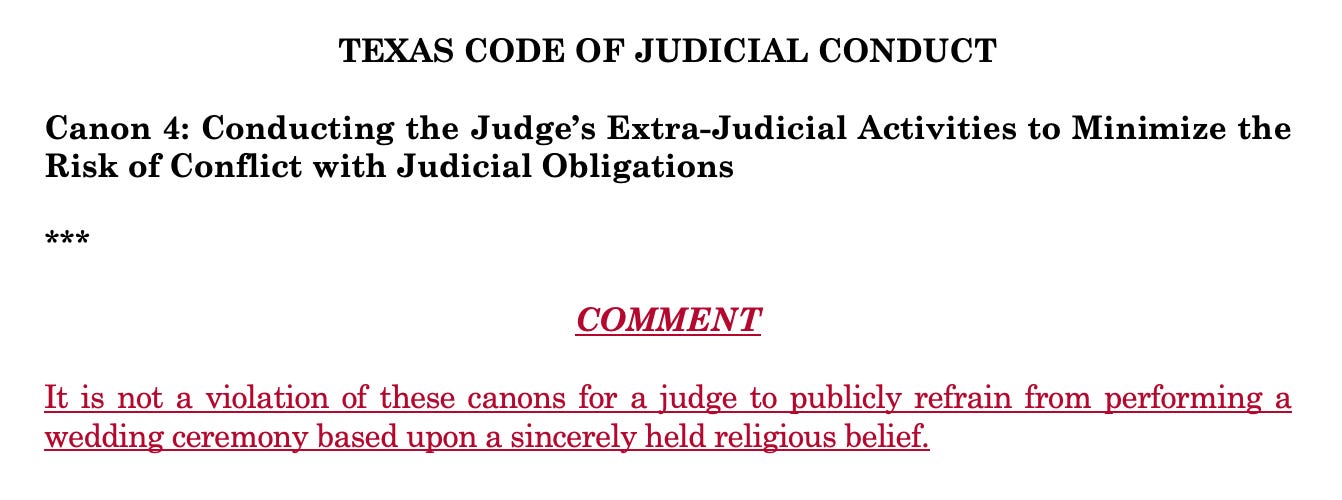
How did they make the change? The Court altered the state’s judicial conduct code—the ethics rules for judges—by saying “It is not a violation of these canons for a judge to publicly refrain from performing a wedding ceremony based upon a sincerely held religious belief.”
Canon 4, by the way, is a set of rules dictating how judges should act in their free time so that people have no reason to doubt their impartiality in cases. It includes common sense items like how judges can join non-profit groups but not if those groups are likely to appear before the court. But now, all eight justices said, another item could be added to that list: There was no violation of the ethical rules if judges refused to perform weddings because their religion says those couples are sinning.
It wasn’t a ruling on her case. It was just a coincidental rule change… that gave Hensley everything she ever wanted. It also raised a number of other ethical questions. For example, couldn’t that same edict be used to allow judges to avoid ethical consequences if they refused to perform wedding ceremonies for mixed-race couples, or mixed-religion couples, as long as their bigotry stemmed from their faith? What about people who had sex before marriage if pre-marital abstinence was a principle of their religion?
And even if the ethical code for judges now permitted faith-based bigotry, it didn’t change the law itself. Which meant that if a gay couple went to a Texas court to get married, and a judge refused to sign off on it because of his or her faith, the gay couple could still file a lawsuit against that judge.
The entire situation left gay couples in Texas in a bind. On paper, they were free to get married if they chose to. But the state’s highest court now said judges who didn’t want to perform the ceremony and sign the necessary documents were free to do so.
It was state-sanctioned discrimination.
In any case, Hensley has already moved on to the profit stage of this particular grift.
On Friday, the District Court of Travis County announced that Hensley would receive the $10,000 in damages along with $630,000 in legal fees, paid by the State Commission on Judicial Conduct. (No wonder her lawyers with First Liberty are celebrating.) Meanwhile, other similar cases are still moving through the courts because plenty of other right-wing judges also want to get rich off of their hate.
“Although the Hensley litigation has concluded, the Commission is still facing a statewide class-action lawsuit on behalf of justices of the peace who were unwilling to perform same-sex marriages and stopped performing weddings entirely to avoid disciplinary action from the Commission,” First Liberty Institute added. “The class action is seeking damages in the tens of millions of dollars for income lost by justices of the peace throughout the state.”
Yes, why won’t anyone think about the poor justices of the peace who refuse to follow the law and can’t perform their side hustle…?
Naturally, her team thanked Texas Attorney General Ken Paxton (now a scandal-prone candidate for U.S. Senate) for his guidance:
“Judge Hensley always adhered to the law and the legal guidance provided by the Attorney General of Texas,” said Hiram Sasser, Executive General Counsel for First Liberty Institute. “We are grateful that this case has concluded and that Judge Hensley was vindicated.”
Hensley’s “victory” here amounts to a declaration that prejudice is perfectly compatible with public service as long as you’re Christian. Instead of standing for equality under the law, people like Hensley have decided religion—and realistically, only their religion—supersedes the rules everyone else has to follow. All so that they can further discriminate against people who are already struggling to protect their rights across the state.
Hensley, by the way, filed a separate federal lawsuit last December urging the Supreme Court to overturn Obergefell. I guess she figures she’s on a roll when it comes to harming gay couples, so she may as well keep going.
(Portions of this article were published earlier)
Please share this post on Reddit, Facebook, or the godawful X/Bird app.
Sen. Tommy Tuberville, R-Ala., has recently bad-mouthed the Freedom From Religion Foundation’s criticism of the Auburn University baseball team coach leading players in prayer and the inclusion of crosses and the phrase “Jesus won” on team gear. FFRF Co-Presidents Dan Barker and Annie Laurie Gaylor have released the following statement in response:
Sen. Tuberville’s comments demonstrate a fundamental misunderstanding of both the Constitution and FFRF’s mission. The First Amendment protects every American’s right to practice their religion — or no religion at all — free from government coercion. It does not permit public university employees to use their official positions to promote Christianity to student-athletes.
FFRF has never objected to private religious expression by Auburn players, coaches or anyone else. What we object to is a public university baseball program using its official authority to organize team prayer and promote sectarian religious messages through university-sponsored athletics. Student-athletes come from a variety of religious backgrounds — and public university officials have a duty to respect that diversity rather than use their positions to advance a particular faith. Student-athletes should never be made to feel that participation on a public university team requires conformity to a coach’s religious beliefs.
Sen. Tuberville is also mistaken when he claims the United States was founded on “freedom of religion, not freedom from religion.” The Founders deliberately rejected religious establishments and created a secular Constitution that guarantees freedom of conscience for believers and nonbelievers alike. Religious freedom necessarily includes freedom from government-imposed religion.
As for the accusation that FFRF “hates God and America,” such rhetoric is as tired as it is false. FFRF’s members include patriotic Americans from every walk of life who are dedicated to defending the constitutional principle of church-state separation. We will continue standing up for the rights of all students, including Auburn’s Christian students, to make their own religious choices free from pressure by government officials.
The issue here is not whether Auburn players may pray or otherwise express their faith. They absolutely may. The issue is whether public university employees may use their positions of authority to promote Christianity through official team activities. The Constitution’s answer is: No.
Religious freedom means every student gets to decide for themselves what to believe. It does not mean government officials get to decide for them.
The Freedom From Religion Foundation, the largest association of freethinkers (atheists, agnostics and humanists) in North America, is a national nonprofit organization with about 41,000 members nationwide, including hundreds of members in Alabama. FFRF’s purposes are to defend the constitutional principle of separation between church and state, and to educate the public on matters relating to nontheism.
This newsletter is free and goes out to over 24,000 subscribers, but it’s only able to sustain itself due to the support I receive from a small percentage of regular readers. Would you please consider becoming one of those supporters? You can subscribe via Patreon or the Subscribe button below! You can also make one-time donations through Venmo or PayPal.
In a stunning turn of events, a Christian high school in Tennessee has agreed to pay a former student $10,000 after denying her the chance to walk at graduation, which they did after she publicly came out as a lesbian and suggested some of her more conservative/Trump-y relatives may not take the news well.
I first wrote about Morgan Armstrong last year, but the story is so damn amazing, I’m reposting it here with relevant updates.
Morgan was a high school senior and star basketball player last year, but just before she was set to graduate, administrators told her family they needed to have a meeting.
Morgan Armstrong (via Facebook)
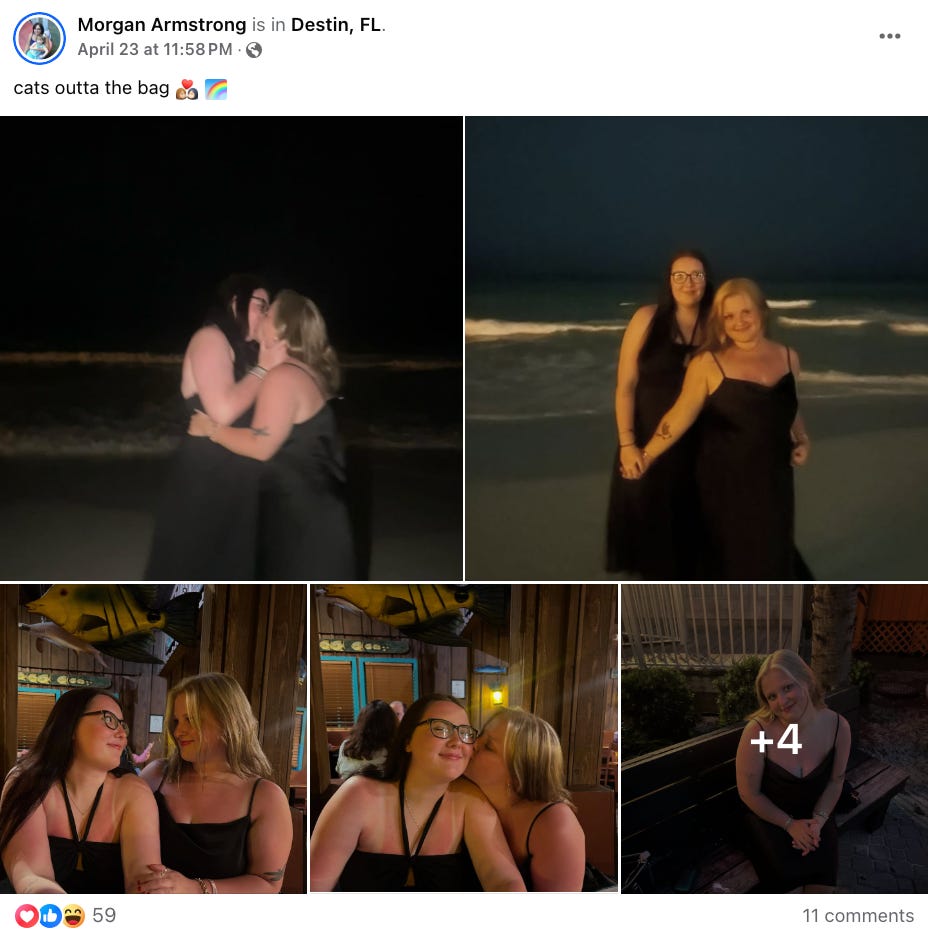
Turns out they had seen a public post on Morgan’s Facebook page highlighting her same-sex relationship. She posted it shortly after turning 18.
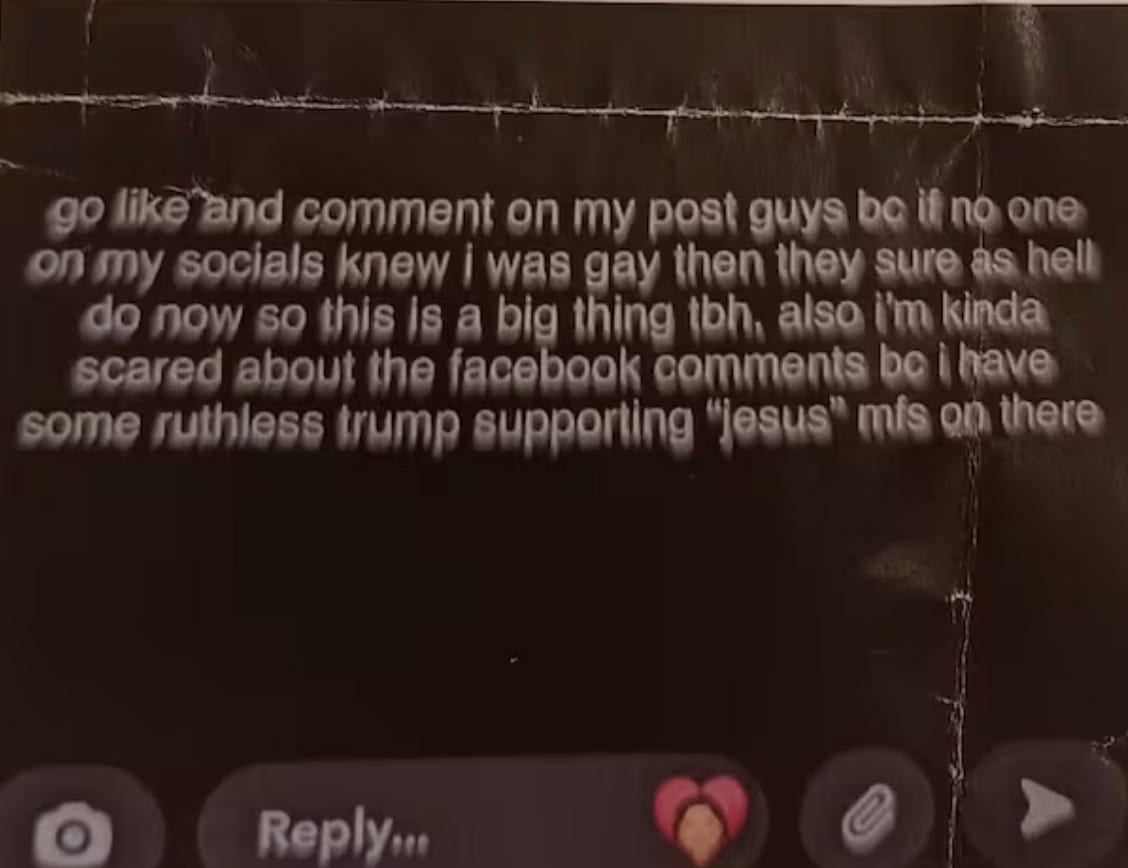
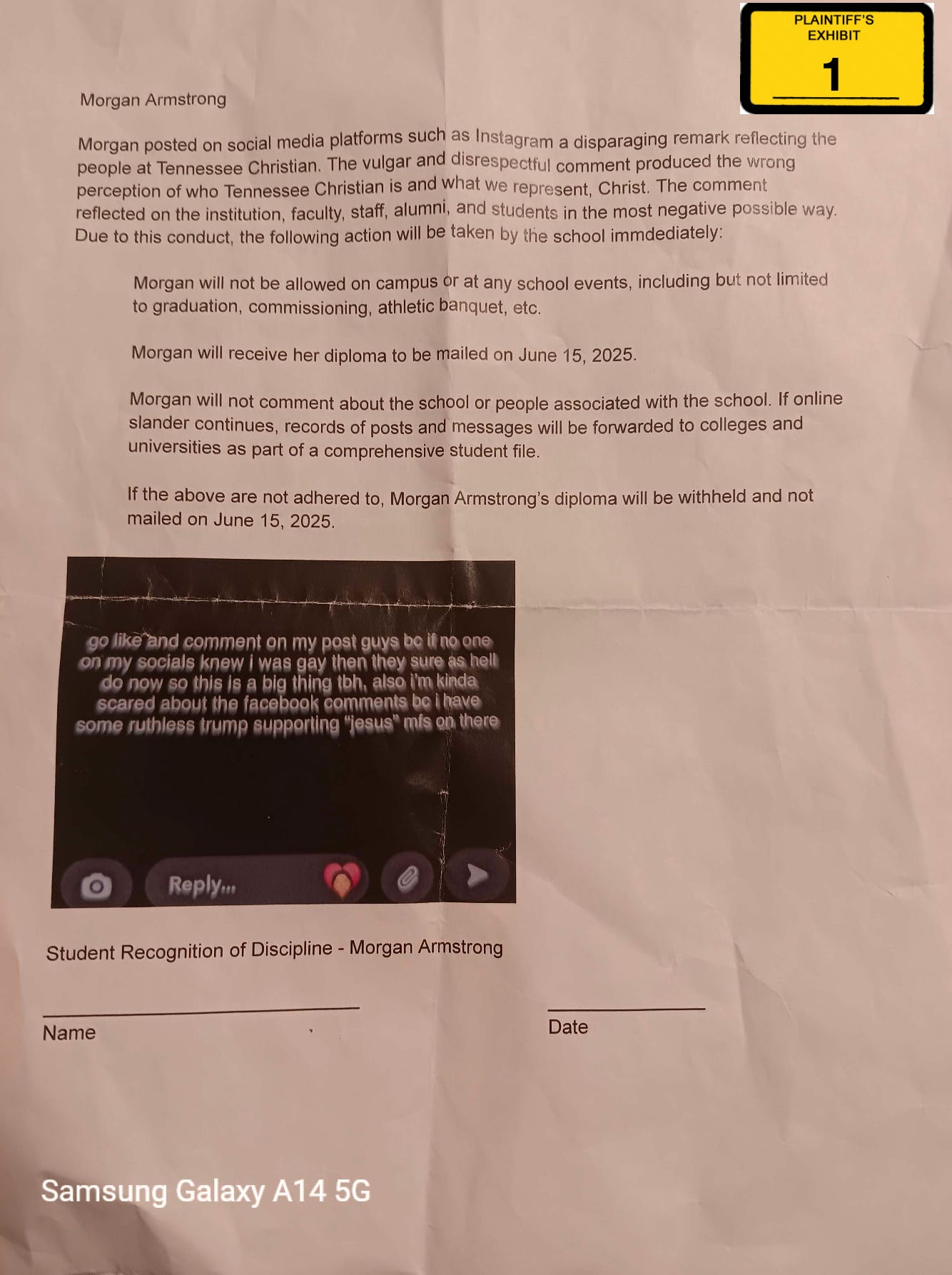
Administrators had also seen a private message posted for her Snapchat friends asking them to “like” her post because she had a lot of Trump-supporting acquaintances. That message, which one student must have leaked to school officials, said: “Go like and comment on my post guys bc if no one on my socials knew i was gay then they sure as hell do now so this is a big thing tbh, also i’m kinda scared about the facebook comments bc i have some ruthless trump supporting ‘jesus’ mfs on there.”
It was clear what she meant by that. There are a lot of conservative Christian bigots who might respond to her post by telling her she’s some kind of sinner who needs Jesus. Not all Christians are bigots, obviously, but the Trump-supporting ones? Gotta watch out for them. And she had people in her life who fit that description.
I knew what she was saying. You knew what she was saying. But why did the school give a damn what she was saying?
Simple: Morgan attended Tennessee Christian Preparatory School, one of those schools where “homosexual behavior” is not allowed. But that’s not why she was in trouble, apparently. According to the adults at the school, the problem was acknowledging the open cruelty of Trump supporters. They said she violated their Social Media Policy by disparaging those bigots… because she was effectively disparaging them.
Armstrong and her father said they met with principal Kylie Machacek and head of schools Jared Tilley.
Armstrong said the school presented the family with a letter, referring to the post and the private message that they had obtained. That letter read, “Morgan posted on social media platforms, such as Instagram, a disparaging remark, reflecting the people at Tennessee Christian. The comment reflected on the institution, facility, staff, alumni and students in the most negative possible way.”
If you read a post calling out conservative Christian bigots and your first response is, “How dare she talk about us like that?”… then maybe you’re the problem.
She didn’t mention the school, or any of her teachers, or any of her classmates in any of those posts. She correctly pointed out there were assholes out there—there are!—and the school overreacted by assuming she was targeting them.
The school’s policy says students cannot post anything that’s “threatening, harassing, illegal, obscene, defamatory, slanderous, harassing, bullying, or hostile towards any individual or entity.” But she wasn’t “defamatory” or “slanderous” or even “hostile” regarding what bigots do; she described them accurately! So what was the big deal?
In any case, because of their overreaction, the school officials banned Morgan from attending graduation as well as any end-of-season athletic banquet.
They also told her they’d mail her the diploma in a month because they refused to give it to her on stage.
Then they threatened to sabotage her future by sending proof of her posts to her prospective colleges, like some kind of bizarre academic blackmail.
Morgan will not comment about the school or people associated with the school. If online slander continues, records of posts and messages will be forwarded to colleges and universities as part of a comprehensive student file.
Again, she never slandered the school or anyone in it. But if she continued, the school insisted, she wouldn’t get her diploma at all.
Her parents, who were both openly in support of their daughter, couldn’t believe it:
“I was shocked and then I went to anger,” said Monica Armstrong, Morgan’s mother.
I want to reiterate that the school didn’t comment on her relationship—even though, deep down, you just know that’s what this was all about. They focused on her (honest) admission that conservative bigots wouldn’t like it… which they took as a personal insult for some reason. Because of that interpretation, they were threatening to punish her with whatever leverage they still had.
But the school made a huge mistake.
While private Christian schools have every right to set their own ridiculous policies, the expectation is that they’re at least going to honor what both sides agreed to in writing.
That created a problem for administrators. Because even if you believe Morgan violated the school’s rules, the school’s handbook said a first-time violation for breaking their Social Media Policy was, at worst, a one-day in-school suspension. Not banning someone from attending her own graduation and refusing to hand over the diploma she earned.
By going from 0 to 60 at the first sign of pushback, the school was ignoring its own stated rules.
That’s why Morgan’s family filed a lawsuit against the Christian school. They said the letter she received “falsely” stated she was insulting people at the school.
Nothing in Morgan’s public post was vulgar, disrespectful, or slanderous, and the post does not refer to the Defendant in any respect.
They said the same thing about her private Snapchat request—she wasn’t talking about the school or the people in it. She was referring to bigots in her extended family, not good kind Christians. (And surely the folks at Tennessee Christian Preparatory School are good kind Christians, right?)
Instead, Morgan’s statement describing “some ruthless trump supporting ‘jesus’ mfs” referred to members of Morgan’s own family with whom she was connected on social media—people who, in Morgan’s view, profess but do not practice Christian principles of love, acceptance, and compassion.
This section, in my mind, is what everything boiled down to:
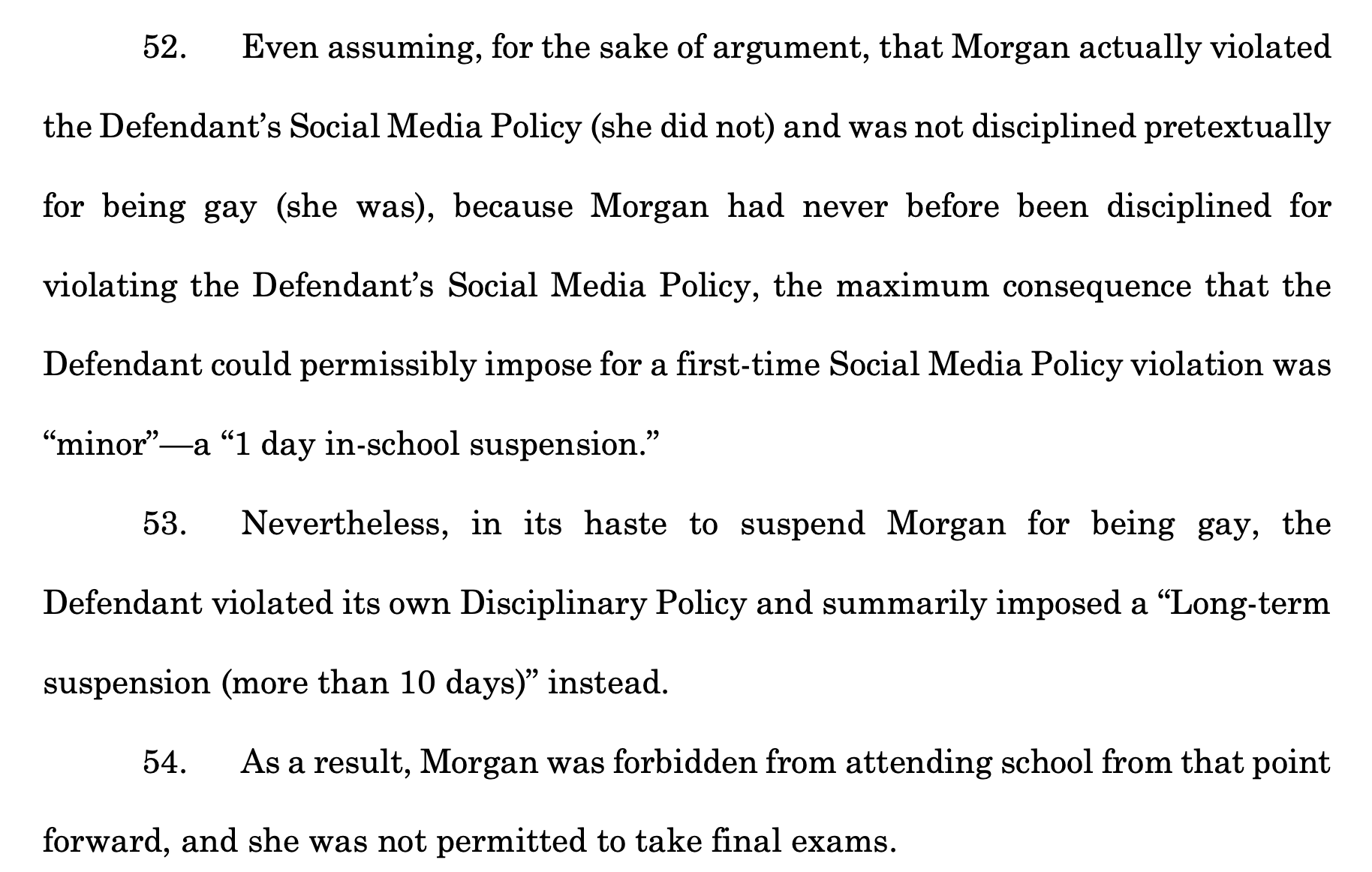
52. Even assuming, for the sake of argument, that Morgan actually violated the Defendant’s Social Media Policy (she did not) and was not disciplined pretextually for being gay (she was), because Morgan had never before been disciplined for violating the Defendant’s Social Media Policy, the maximum consequence that the Defendant could permissibly impose for a first-time Social Media Policy violation was “minor”—a “1 day in-school suspension.”
53. Nevertheless, in its haste to suspend Morgan for being gay, the Defendant violated its own Disciplinary Policy and summarily imposed a “Long-term suspension (more than 10 days)” instead.
54. As a result, Morgan was forbidden from attending school from that point forward, and she was not permitted to take final exams.
You have to wonder what the school thought it would accomplish by punishing one of its best students for something so harmless. Instead of giving her the sendoff she deserved, they ruined what should have been highlights of her high school experience.
The lawsuit ended with a request that, if the school lost the case, they remove the suspension from her record, allow her to take her final exams, give her the damn diploma, stop threatening her college prospects, and pay any associated legal costs. (The school said she didn’t have to take the final exams, and they wouldn’t hold it against her grade-wise. Still, if she scored well on them, it could have improved her grade point average. That’s why she really wanted a chance to show what she could do.)
At the time, the school issued a press release “firmly [rejecting] the misleading allegations outlined in a recent lawsuit supposedly filed against the school.”
The irony in all this was, by punishing Morgan over nothing, the administrators confirmed what critics of Christian schools often say: These institutions are hotbeds of bigotry. They have no love for LGBTQ students. They pressure students to suppress their emotions. They make a big deal over little things while ignoring much more serious problems.
It’s mind-boggling that any private school would rather withhold a student’s diploma for expressing genuine concern about the inevitable reactions to her relationship than just let it slide because no reasonable person would actually give a damn.
The silver lining to all this was that there was an overwhelmingly positive response on behalf of Morgan. News outlets covered the story and any neutral explanation of what happened made the school look absolutely horrible. But they brought this upon themselves. That’s the price you pay when bigotry is your biggest selling point.
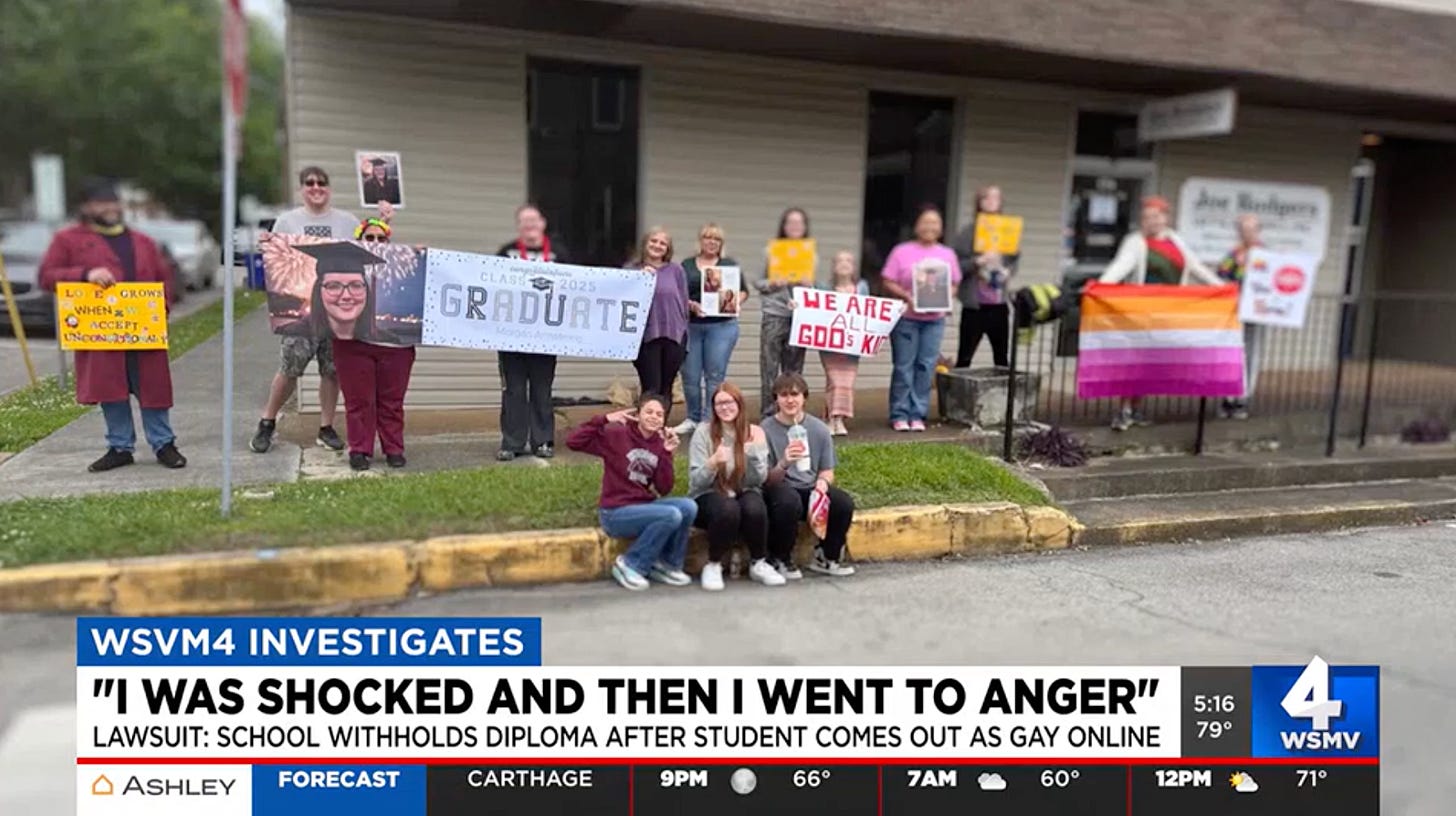
Meanwhile, Morgan’s family held a small protest/celebration on the day she was supposed to be graduating with her classmates:
A graduation celebration for Morgan Armstrong (screenshot via WSMV)
When I spoke to Morgan last year, I learned a lot more about her situation than the media coverage revealed.
For example, the biggest question I had was why she ended up going to a conservative Christian school in the first place. If she and her parents were relatively progressive on LGBTQ issues, what drew them there? That answer was extremely straightforward: The school offered Morgan a spot on their basketball team back in middle school along with a partial scholarship to go with it, and her family decided that was an offer they couldn’t turn down. While they are Christian, they didn’t see their values as clashing with the school’s idea of religion… until now. When it came to how she felt about Christianity, Morgan told me, “this situation definitely didn’t help.”
I also wondered why she decided to post the pictures of her and her girlfriend in the spring instead of just waiting a month or two until she was finally done with high school. Morgan said she did that on purpose. She had known for years that she’s attracted to other girls, and she’s also known her school disapproves of that, and “I didn’t want that fear to hold me down anymore.” Plus, she added, her straight friends posted pictures with their boyfriends and girlfriends all the time. So why couldn’t she?
That’s also why she filed the lawsuit. Even if the school won’t change its stance on homosexuality, she didn’t want them to target anyone else in the future like they did to her. In fact, she received so many messages and calls of support from former students at her school who are now openly LGBTQ. She wanted the “continuous cycle” of shame and hate to end.
It wasn’t all supportive, though. Morgan said her friends at school mostly blocked her on social media after this controversy went public. Maybe that’s to avoid the wrath of the school’s prying eyes, but it’s not like they contacted her privately either to let her know they were still on her side.
The irony, she said, was that many of them had known she was gay for years. It was only after this story went viral that they decided to cut their ties. Her girlfriend Sophie, however, was right there with her. (It must have been hard to watch Morgan go through all this, but the two were still as close as ever.)
When we spoke, Morgan didn’t know where she’d go to college. She figured she wouldn’t be playing basketball anywhere, but for her sake, I hoped she would end up in a place where she would be accepted and not treated as some kind of outcast.
I had mostly forgotten about this story, assuming nothing much would come of it. I figured Morgan would go to college, the school wouldn’t admit any wrongdoing, and both sides would move on.
I was wrong.
This week, her attorney Daniel A. Horwitz announced that the two sides had reached a settlement. While the two sides “disagree” on whether Morgan violated school policies, the school has retroactively rescinded her suspension. Administrators also said they never trashed Morgan to any of her prospective colleges and promise never to do so in the future.
And the school said they’d pay her $10,000. Which is essentially the amount for tuition for a single year (even though Morgan had received at least a partial scholarship).
In an interview Horwitz told me “this is as good a result as—perhaps an even better result than—the court system could have provided in a litigated judgment. Paired with the rescission of her suspension, her receipt of her diploma, and the permanent injunction involved, this was a total, spectacular win.”
Horwitz, who worked on this case pro bono, added in a press release:
… “School is a place where every student is entitled to feel welcome, accepted, and supported.”
Horwitz continued, “It is not a place where any administrator should feel comfortable disciplining or threatening kids for being gay. We were proud to represent Morgan and her family in this righteous lawsuit, and we are thrilled to have prevailed on their behalf. We hope Morgan’s bravery will inspire others to stand up for themselves the way that she did.”
I also had a chance to catch up with Morgan yesterday. She told me she was just glad everything was over since this issue had taking up a lot of space in her brain over the past year.
She’s currently attending a college online while working a full-time job, making a clean break from her high school and the area where she grew up. And she’s still with Sophie, who’s been supportive throughout this whole ordeal.
When we spoke last year, she told me she was on the fence about her Christian faith, saying “this situation definitely didn’t help.” So where was she on that now? “I’m still questioning,” she told me, adding that she was probably “leaning to the not-believing side.” When so many of your interactions with Christians are as negative as the ones she’s had, it’s hard to argue with that.
It’s also the same reason she’s not particularly close to the people she attended high school with. Many of them had blocked her on social media last year when everything went down. I figured some of them would come around after the controversy subsided… but they didn’t. Morgan said they still have her blocked and the feeling is mutual. “At first, it was a bad thing,” she said, but these days, she’s “made peace with it. What’s done is done.” (She’s building a new life in a new city, and that may be the healthiest option.)
The biggest thing she wanted to say was that she had seen chatter on social media that she did this for attention or money. But no one asks for this kind of attention, and she never wanted money from the school anyway. (Remember, it was the school that offered money as part of the settlement.) There was only one reason Morgan wanted to go through with this lawsuit, she explained: “It was about standing up for what happened. My only goal was to clear my record.”
Please share this post on Reddit, Facebook, or the godawful X/Bird app.
The Freedom From Religion Foundation is applauding Major League Baseball for reportedly standing firm against politically motivated accusations of religious discrimination.
Several San Francisco Giants players were warned recently for writing spiteful bible verse citations on their caps during a Pride Night game. In a letter sent to MLB Commissioner Rob Manfred, FFRF has commended the league for standing by its neutral uniform policies and resisting efforts by politicians and government officials to portray routine workplace rules as anti-Christian discrimination.
“Religious liberty is a fundamental American value, but it does not entitle individuals to disregard neutral workplace rules or demand preferential treatment,” FFRF Co-Presidents Annie Laurie Gaylor and Dan Barker write. “By maintaining that distinction, MLB has demonstrated that it is possible to respect religious freedom while also preserving an inclusive environment for all.”
The controversy stems from the San Francisco Giants’ annual Pride Night game on June 12. During the event, players wore caps featuring a rainbow-colored Giants logo. Several Giants pitchers reportedly wrote bible verse citations on those caps, including references to Genesis 9:12-16, a passage that discusses God’s covenant after the flood and describes the rainbow as a sign of that covenant.
Major League Baseball subsequently warned the players that adding unauthorized messages to league-issued uniforms violated league rules.
That decision drew criticism from several conservative elected officials and political appointees, including House Speaker Mike Johnson, Sen. Josh Hawley, R-Mo.,Florida Attorney General James Uthmeier and Assistant Attorney General Harmeet Dhillon, who have characterized MLB’s actions as religious discrimination. Dhillon has reportedly asked the Equal Employment Opportunity Commission (EEOC) to investigate the matter. FFRF says those claims fundamentally misunderstand both religious liberty and anti-discrimination law.
“The issue is not whether the players are Christian or whether they quoted scripture,” FFRF writes. “The question is whether individual players may alter league-issued uniforms to display personal messages in violation of league policy. The answer is plainly no.”
The state/church watchdog notes that employers routinely distinguish between official organizational messaging and unauthorized personal expression. A player would not be entitled to add political slogans, ideological messages or other personal statements to league-issued apparel — and religiously motivated messages are no different.
“Religious belief does not confer a right to disregard neutral workplace rules,” FFRF explains. “An employee does not gain a special exemption from generally applicable policies merely by invoking religion.”
FFRF also rejects the claim that enforcing a neutral uniform policy constitutes religious discrimination.
“Anti-discrimination laws protect employees from adverse treatment because of their religion,” the letter states. “They do not require employers to grant special privileges to religiously motivated expression or exempt religious employees from workplace rules that apply equally to everyone else.”
The organization expressed particular concern over reports that the Department of Justice has asked the EEOC to investigate MLB.
“The Civil Rights Division exists to combat genuine discrimination, not to transform religious liberty into a weapon against organizations that seek to create welcoming environments for historically marginalized communities,” FFRF writes.
FFRF notes that Pride Night events are intended to ensure that LGBTQ+ fans, players and families feel welcome in a sport that has not always been inclusive.
“Such initiatives are not anti-Christian, anti-religious or discriminatory,” the letter states. “They simply reflect the principle that every person deserves equal dignity, respect and inclusion.”
The Freedom From Religion Foundation is a U.S.-based nonprofit dedicated to defending the constitutional principle of separation between state and church and educating the public on matters relating to nontheism. With about 41,000 members, FFRF is the largest association of freethinkers (atheists, agnostics and humanists) in North America. For more information, visit ffrf.org.
This week, Metro Weekly cited my reporting in a piece about a Christian family’s lawsuit over a transgender wrestler. They said, “As reported by Hemant Mehta in his The Friendly Atheist Substack, multiple wrestlers, coaches, and parents of youth wrestlers who reviewed the video said they saw nothing abnormal.” The work you support is helping change the narrative about controversial issues. Please help me continue doing it via Patreon or the Subscribe button below! You can also make one-time donations through Venmo or PayPal.
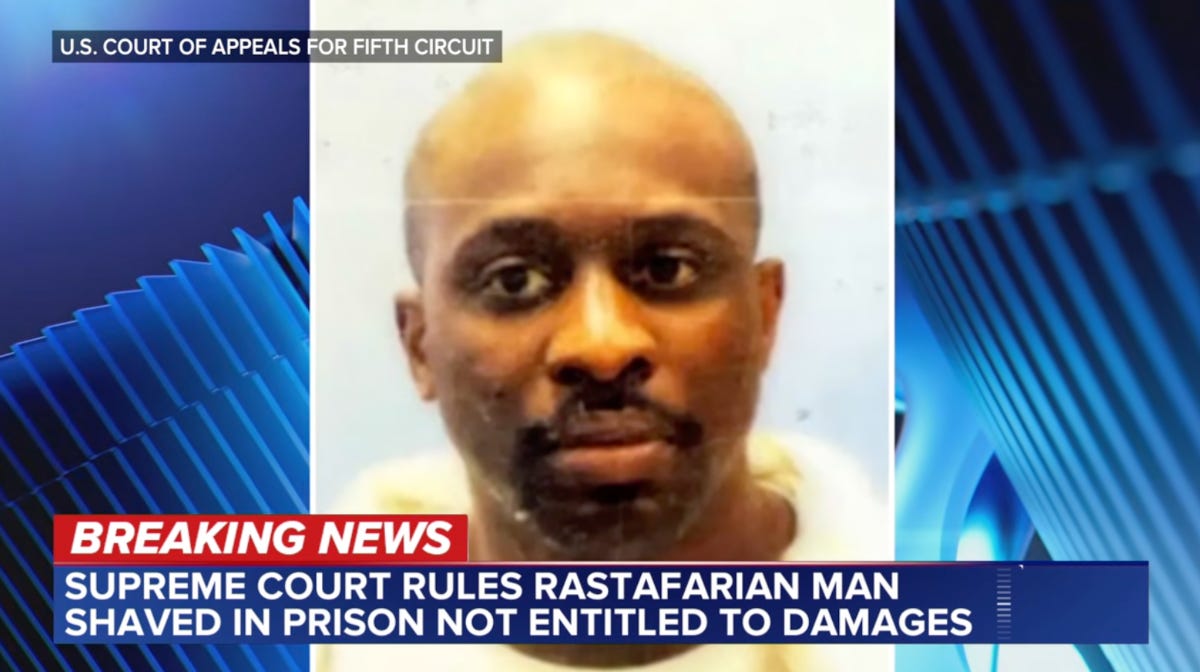
The Supreme Court has made it official: Religious freedom only applies if you’re a conservative Christian. The conservative super-majority ruled 6-3 on Tuesday, along partisan lines, that a Rastafarian man whose hair was cut off against his will—violating his religious beliefs—had no legal remedies available to him.
The case centered around Damon Landor, who hadn’t cut his hair in decades because he follows the Nazarite vow—which includes a reference to Numbers 6:5: “… No razor may be used on their head… they must let their hair grow long.”
He continued that vow even after entering two Louisiana jails in 2020, for a five-month sentence over a drug-related charge. When he was transferred to a third facility—the Raymond Laborde Correctional Center—Landor worried they might try to cut his hair to fit in with inmate grooming policies, so he showed officers paperwork that said federal law was on his side: The Religious Land Use and Institutionalized Persons Act of 2000 (RLUIPA) basically says prisons that receive federal funding can’t violate someone’s religious beliefs unless there’s a really good reason for it.
The officers didn’t care. They threw his paperwork in the trash, handcuffed him to a chair, and shaved off his hair.
He later sued, seeking damages from both the prison and the individual officers for violating his rights. The lower courts ruled against him, but the Supreme Court took up his case. Unfortunately, the conservatives have now also dismissed his arguments, leaving him with no more recourse.
Writing for the majority, Justice Neil Gorsuch said the individual officers never consented to following RLUIPA, so they couldn’t be held accountable for what they did… as if it was okay for them to violate the law because they didn’t know any better. Even though the state-run prison received federal funding and essentially agreed to follow federal law as a result, he argued, the same couldn’t be said of the employees.
In this case, Gorsuch continued, the Louisiana Department of Corrections “does not dispute that it is a recipient of federal funds” and “that it has agreed” to be sued by private plaintiffs under RLUIPA “as a condition of accepting those funds.” But Landor does not contend that the prison officials who are the defendants in his lawsuit have “voluntarily and knowingly consented to answer private suits under RLUIPA,” Gorsuch noted, and therefore his lawsuit against them cannot go forward. Gorsuch wrote, for example, that it did not matter that the prison officials received paychecks from the Louisiana Department of Corrections, which in turn received federal funding, so that they “should be deemed to have implicitly consented to RLUIPA liability.”
If that sounds ridiculous, that’s because it is. Alexis Romero and Mark Joseph Stern of Slate couldn’t believe that line of reasoning:
… the state officials in this case arguably did agree to be bound by federal law. After all, they signed an employment contract with a prison that receives federal funding by virtue of RLUIPA. State officials are trained on their inmates’ rights, and prison litigation has been around for centuries, under RLUIPA and other statutes. There’s no serious argument that these state officials were blind to the consequences that might come from violating the rights of the prisoners they’re in charge of.
The liberal justices said as much in their dissent, adding that the majority just gave federal employees permission to ignore RLUIPA whenever they want.
Justice Ketanji Brown Jackson, joined by Justices Sonia Sotomayor and Elena Kagan, dissented. She argued that, as a result of the majority’s ruling, “[p]risoners like Landor who suffer violations of their religious freedom in state prisons—no matter how blatant—will often be left remediless. And encroachments on prisoners’ statutory rights are likely to happen with fair frequency, as state-empowered prison officials will have little incentive to abide by federal law, even if it is handed to them on a piece of paper.”
To get a little more technical, Gorsuch justified his decision by saying his issue was with the way Congress worded RLUIPA, but with a dysfunctional Congress run by Republicans, there’s no quick fix even if the correction is obvious. (Ian Millhiser of Vox notes that this could have a serious effect on women who need emergency abortions in red states.)
What makes this decision all the more infuriating is that everyone seems to agree that Landor’s rights were violated. The conservatives on SCOTUS said it. The state admitted it, too, even saying they had changed their rules to prevent this kind of incident in the future. But the ruling still means Landor can’t receive any sort of compensation for what he went through.
“We condemn the conduct as alleged in this case and have taken steps to prevent this problem from recurring, but we are grateful the court agreed with the state in this matter,” Louisiana Attorney General Liz Murrill, a Republican, said in a statement.
She added that religious rights are “deeply important” but that the state has its own laws that protect them.
Americans United for Separation of Church and State had filed an amicus brief in this case on Landor’s behalf, saying RLUIPA permitted lawsuits against individual officers. They even said, “Without the possibility of individual liability, officers (and institutions) can blatantly and/or repeatedly violate RLUIPA with few to no consequences.” They were, of course, disappointed with Tuesday’s decision:
“Today’s U.S. Supreme Court decision endangers the religious freedom of incarcerated people, like Damon Landor, who are particularly vulnerable to abuse and having unnecessary burdens placed on their religious exercise. Once again, we see a court that will bend over backward for the religious freedom of Christians, but allows the government to trample the religious freedom of non-Christians. We can only hope this faulty decision doesn’t embolden more prison officials to ignore the religious-freedom rights of incarcerated people to observe their faith as long as they don’t harm others.”
That’s really the big takeaway here. The Supreme Court has rewarded Christians who filed religious freedom lawsuits even when the facts were not on their side (like Joe Kennedy) or when they suffered no actual damages (like the wedding website creator). Here’s a Rastafarian whose story is not in dispute and who actually suffered, and the Supreme Court’s conservatives are giving him a pat on the back and nothing of value. Hell, Gorsuch, who went out of his way to give Kennedy a victory by lying about the nature of his case, is the same person now saying there’s nothing he can do for Landor.
This man literally waved the law in front of the officers but the Supreme Court insisted those officers can’t be held accountable for not following the rules. What else could Landor have possibly done?
Even more concerning is how this decision gives a green light to other officers who may want to sidestep the law when it involves a non-Christian inmate, according to Elizabeth Reiner Platt, the director of the Law, Rights & Religion Project.
Without any threat of financial punishment, employees of state jails and prisons can trample inmates’ religious rights with impunity. And while courts may still order prisons to accommodate incarcerated people’s religious beliefs — such as by providing halal meals — this means little in cases like Landor’s, when the damage has already been done.
Landor can still theoretically pursue damages through the state courts, but the bottom line is that the Supreme Court used this case to make it even harder for a non-Christian to receive justice even when there’s no dispute about what happened to him. It’s fair to wonder if the outcome would have been different here if a Christian—specifically a white Christian—prisoner was on the receiving end of a faith-based infraction.
If there are no punishments for violating someone’s rights, they’re not really rights at all.
Please share this post on Reddit, Facebook, or the godawful X/Bird app.
With less than two weeks to go before the anniversary of the Declaration of Independence, we’re in the home stretch of hearing “America was founded as a Christian nation and the Declaration proves it.” The Religious Liberty Commission report is due any day. So, one more time, I’m going to knock that statement down and then I’ll move on;
The Declaration of Independence was a break-up letter with England, not the establishment of a new country or government. It says the separate colonies are now independent, not that they are a new nation, Christian or otherwise.
The Declaration primarily includes 27 grievances with England. None of them mention religion or even the powerful Church of England.
The Declaration mentions “the Creator” and “Nature’s God” which many cite as proof of the Christian nation claim. But that evidence alone is just too flimsy when you read it.
One year later, in 1777, the states agreed to the Articles of Confederation which set up a government without mentioning Christianity, God, the Bible, and which mentions religion only once briefly in a section on trade. No Christian nation evidence there.
Twelve years later the Articles were replaced by the Constitution which again did not in any way set up a Christian government for a Christian country. The word ‘religion’ is only mentioned one time when it says there will be no religious test for any public office. The Constitution does not mention God or Christianity. It’s really the opposite of saying, “This will be a Christian nation.”
The pro-Christian nation side points out correctly that the Constitution does not include the phrase “separation of church and state.” It also doesn’t mention AR-15s and a thousand other questions that have come up. So for 250 years people have been inferring what the Constitution and Bill of Rights mean based on the text and on outside information from the Founders. That’s where Jefferson’s “wall of separation between church and state” statement comes in. We infer that 18-year-olds can own AR-15s. We infer that there should be a wall of separation between church and state. (Boosted by the Establishment Clause in the First Amendment: “Congress shall make no law respecting an establishment of religion”.
Finally, how important is this whole argument 250 years later? Yes the nation was founded by Christians who were almost entirely Protestants. There were hardly any Catholics then and even fewer Jews and members of other religions. Today we know that 63 percent of the current population is Christian, six percent other religions, and 28 percent people with no religion. The real question isn’t how we were founded, it’s how religious freedom should be applied to today’s population.
Should tax dollars go to support schools that are mostly Christian? Should churches that get a tax exemption be allowed to support political candidates? Should the Ten Commandments be required to be posted in every public school classroom? Can Christian organizations that receive a federal grant proselytize while helping people in need with that grant money? These are the real-life questions that determine whether America is a nation that respects the rights of people from all religions and no religion at all, or whether it gives preference to Christians based on who is in power now.
We know where Jefferson stood on these issues. Madison said religion and government exist in “greater purity, the less they are mixed together”. John Adams signed the Treaty of Tripoli which explicitly declared that the United States is “not, in any sense, founded on the Christian religion.” I think the Founders would be appalled at where we are on these issues now and they would be on social media explaining that this is far from what they envisioned 250 years ago.
At a June 18 event in Michigan, Kennedy announced a $96 million funding opportunity through the Trump administration’s Safety Through Recovery, Engagement, and Evidence-based Treatment and Support (STREETS) program, along with an additional $612 million in behavioral health funding opportunities. Kennedy emphasized that one of the initiative’s goals is to restore federal funding opportunities for faith-based groups.
“One of the features of our STREETS is opening up funding once again for faith-based organizations,” Kennedy said. “The Biden administration actively discouraged funding to faith-based organizations for recovery. We think they’re critical.”
Kennedy also dismissed evidence-based harm reduction strategies, claiming that “harm reduction doesn’t work” and attributing the nation’s addiction crisis to policies such as needle exchange programs and safe consumption sites. However, decades of research have demonstrated that syringe service programs reduce the spread of infectious diseases and connect individuals with treatment services without increasing crime.
Kennedy’s repeated reliance on spiritual and religious narratives to justify federal addiction policy is particularly troubling. During his remarks, Kennedy cited Alcoholics Anonymous and recounted a story involving psychiatrist Carl Jung’s belief that recovery from alcoholism required a “profound spiritual realignment.”
“The federal government should not be steering addiction treatment toward religious approaches,” says FFRF Co-President Annie Laurie Gaylor. “Substance use disorders are medical conditions that require evidence-based interventions, not government-sponsored spirituality.”
This announcement follows a broader effort by the Trump administration to increase the role of religious organizations in federally funded health programs. Earlier this year, the U.S. Department of Health and Human Services formally encouraged faith-based organizations to apply for federal addiction and behavioral health grants, citing President Trump’s executive order last year directing agencies to facilitate the participation of religious entities in government programs.
FFRF has previously warned that these initiatives risk undermining constitutional safeguards and public health objectives.
“Taxpayer-funded public health programs must be secular, science-based and free from religious coercion,” Gaylor says. “Addiction recovery is a medical and public health issue, not a vehicle for government-sponsored evangelism.”
FFRF notes that while religious organizations may compete for public grants on equal terms, the Constitution prohibits the government from favoring religious providers or funding religious activities. Federal dollars may not be used to support worship, religious instruction or proselytizing.
The concerns are heightened because the Trump administration has already rescinded prior protections that required faith-based providers receiving federal funds to inform clients of secular alternatives. The administration has also affirmed that religious organizations may use religious criteria in hiring, even while operating taxpayer-funded programs.
The new initiative will award eight communities up to $3 million annually for four years to develop treatment systems for individuals experiencing homelessness, substance use disorders, serious mental illness and co-occurring conditions. FFRF stresses that any federally funded services must remain accessible to all beneficiaries regardless of religion and must adhere to established constitutional limits.
“Federal health dollars should expand access to proven, inclusive treatment,” Gaylor adds. “They must not be diverted into programs that impose religious doctrine, exclude qualified staff based on faith, or substitute ideology for science.”
FFRF will continue to monitor HHS implementation of these funding programs and urges Congress and federal agencies to ensure that behavioral health funding remains evidence-based, nondiscriminatory and firmly grounded in the separation of state and church.
The Freedom From Religion Foundation is a U.S.-based nonprofit dedicated to defending the constitutional principle of separation between state and church and educating the public on matters relating to nontheism. With about 41,000 members, FFRF is the largest association of freethinkers (atheists, agnostics and humanists) in North America. For more information, visit ffrf.org.
This newsletter is free and goes out to over 24,000 subscribers, but it’s only able to sustain itself due to the support I receive from a small percentage of regular readers. Would you please consider becoming one of those supporters? You can subscribe via Patreon or the Subscribe button below! You can also make one-time donations through Venmo or PayPal.
Two months ago, the Church of Jesus Christ of Latter-Day Saints sued one of its most prominent critics, podcast host John Dehlin, on grounds of trademark and copyright infringement… as if listeners to his show might be confused between the podcast and the Mormon Church itself.
Dehlin is now fighting back in court.
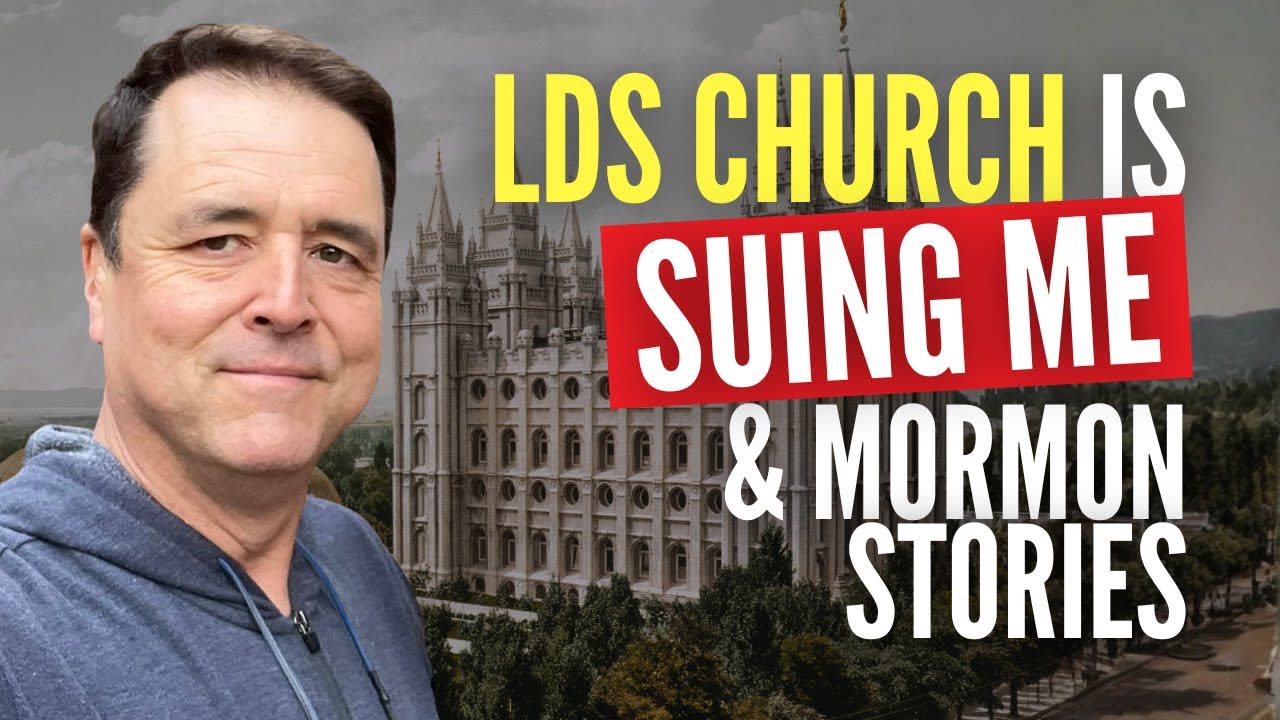
John Dehlin in a thumbnail from his podcast
A quick recap: Dehlin began the Mormon Stories Podcast in 2005 when he was questioning whether or not to leave the LDS Church. It soon became a haven for other critics and former Mormons—and a landing space for listeners who harbored the same doubts but knew the Mormon Church wasn’t a safe place to get their questions answered in a meaningful way.
In 2015, Dehlin was officially kicked out of the Church for the “crime” of apostasy—he was accused of leading people away from the Church—though Dehlin argued the real reason was because he openly and proudly supported same-sex marriage and the ordination of female priests.
The podcast has become popular enough that it spurred the creation of a non-profit group—the Open Stories Foundation—in 2010 to oversee the show and go beyond it. In 2024, the group generated over $1.12 million in revenue.
That’s nothing, of course, compared to the tens of billions of dollars hoarded by the LDS Church. You would think, given all the very legitimate criticism of Mormons from all over the place, the smart move would be to simply ignore what one podcaster is doing, even if he’s popular, in order to avoid the Streisand effect.
But the Mormon Church took the opposite approach. In April, after months of conversations between the two sides, the Mormon Church sued Dehlin, arguing he had no right to use the word “Mormon” or any of their materials.
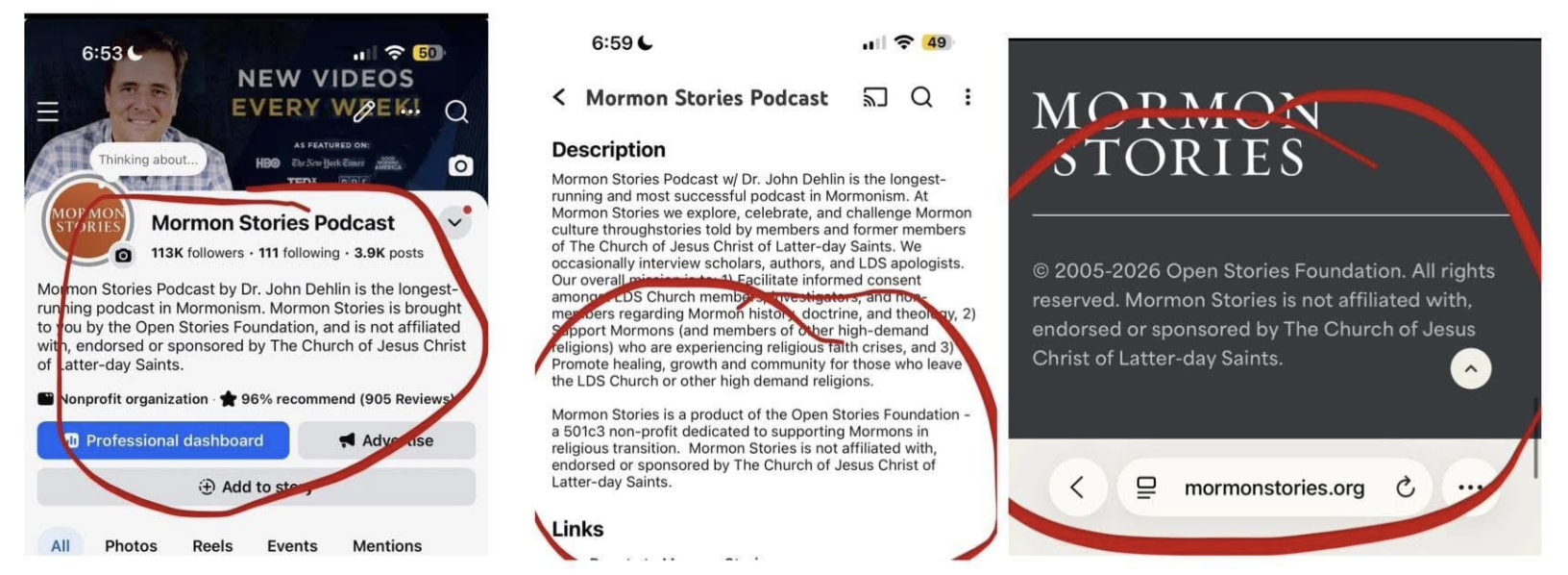
As Defendants are well aware, the public associates the term MORMON with The Church of Jesus Christ of Latter-day Saints, which has used the mark MORMON and other names and marks incorporating the term MORMON since its founding nearly 200 years ago. Defendants’ use of Church trademarks and copyrighted materials has caused and will continue to cause individuals to be confused and access Defendants’ content mistakenly believing it comes from or is affiliated with or endorsed by the Church. This is not by accident. Defendants adopted a blue MORMON STORIES logo with a light-rays design prominently used by the Church, showing Defendants’ intent to capitalize on and increase confusion. Defendants’ logo was calculated to imitate the Church’s logos by using confusingly similar color, font, and other design elements, as shown below.
As I said at the time, in absolutely no world was anyone listening to Dehlin’s podcast and confusing it with Official Church Propaganda. Perhaps there was a case where someone searching for information about Mormonism stumbled across the podcast, but even if that happened, that person would quickly realize it’s not advertising for the LDS Church. After all, why would the banner for the show include Dehlin’s picture—an apostate!—instead of Mormon leaders?
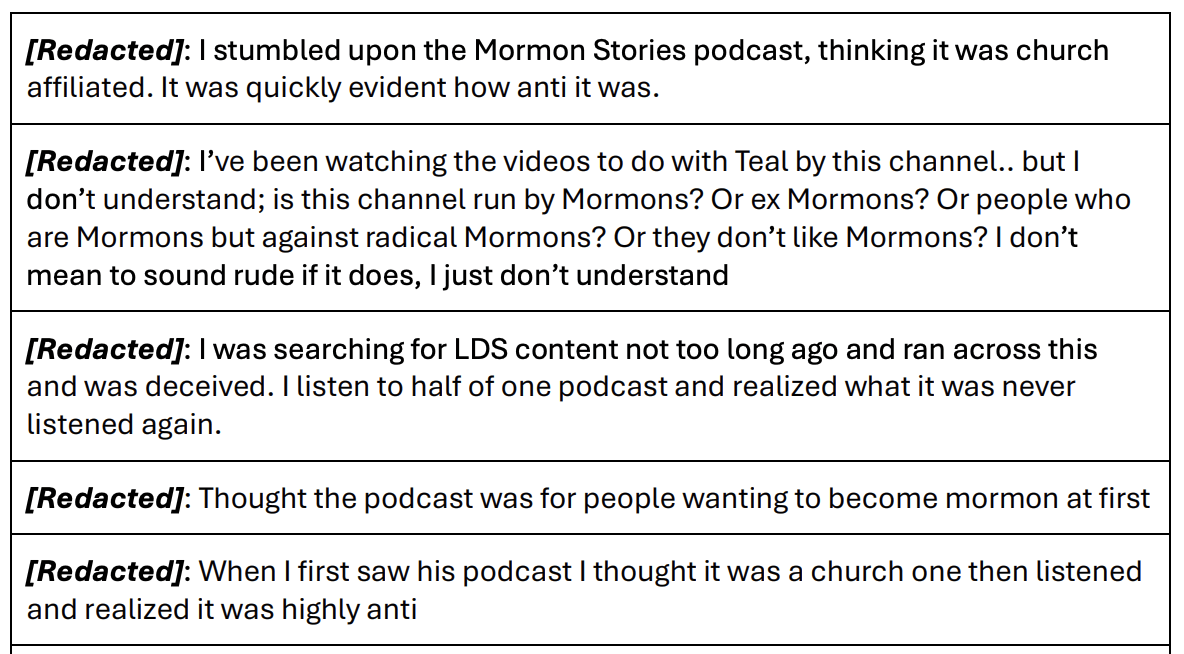
Nevertheless, the Mormon Church insisted there was confusion. To make that argument, the lawsuit included examples, cherry-picked from the podcast’s social media pages, of people who came across it because they believed it was pro-Mormon… only to realize that wasn’t the case. Here’s just a sampling:
There were more comments where those came from, but to me, they all seemed to prove the opposite point. People found Mormon Stories because they had questions about Mormonism… and then realized it wasn’t promoting the LDS Church.
At no point in any of the comments included in the lawsuit did those people say they genuinely confused Dehlin’s words (or his guest’s words) for Church policy. The fact that some of those commenters said they stopped listening immediately after their realization were points in Dehlin’s favor!
(Also, for a podcast this popular, it was deeply unfair for the Church to go searching for comments suggesting confusion was afoot because you’re bound to find anything you want. That’s the nature of popular comment threads. Anyone who spends any time on social knows you can’t always blame the owner of an account for what people say under that account, especially when the owner isn’t baiting it.)
To avoid confusion, the LDS Church demanded that Dehlin include a disclaimer everywhere saying that his podcast wasn’t an official product of the religious sect. But that, too, was beyond parody. No one should have to open their show by explaining which groups they’re not affiliated with.
Making matters worse for the Church, there are pro-Mormon podcasts that use the “M” word in their titles, too, yet there was no indication the LDS Church ever went after any of them for trademark violations even though those podcasts were not official products of the Church either.
This past February, the two sides met in person to discuss their positions.
Dehlin agreed to remove any copyrighted images from his website and social media pages. (The LDS Church says he broke that agreement by later using an image of a temple to advertise an episode.) He changed the logo’s color from Mormon blue to non-Mormon orange. He even added the disclaimer to podcast descriptions on every platform.
What Dehlin refused to do was issue a disclaimer at the beginning of every show “acknowledging that Mormon Stories is not affiliated with the Church.”
That’s why the Church decided to go to court. I felt their case was weak.
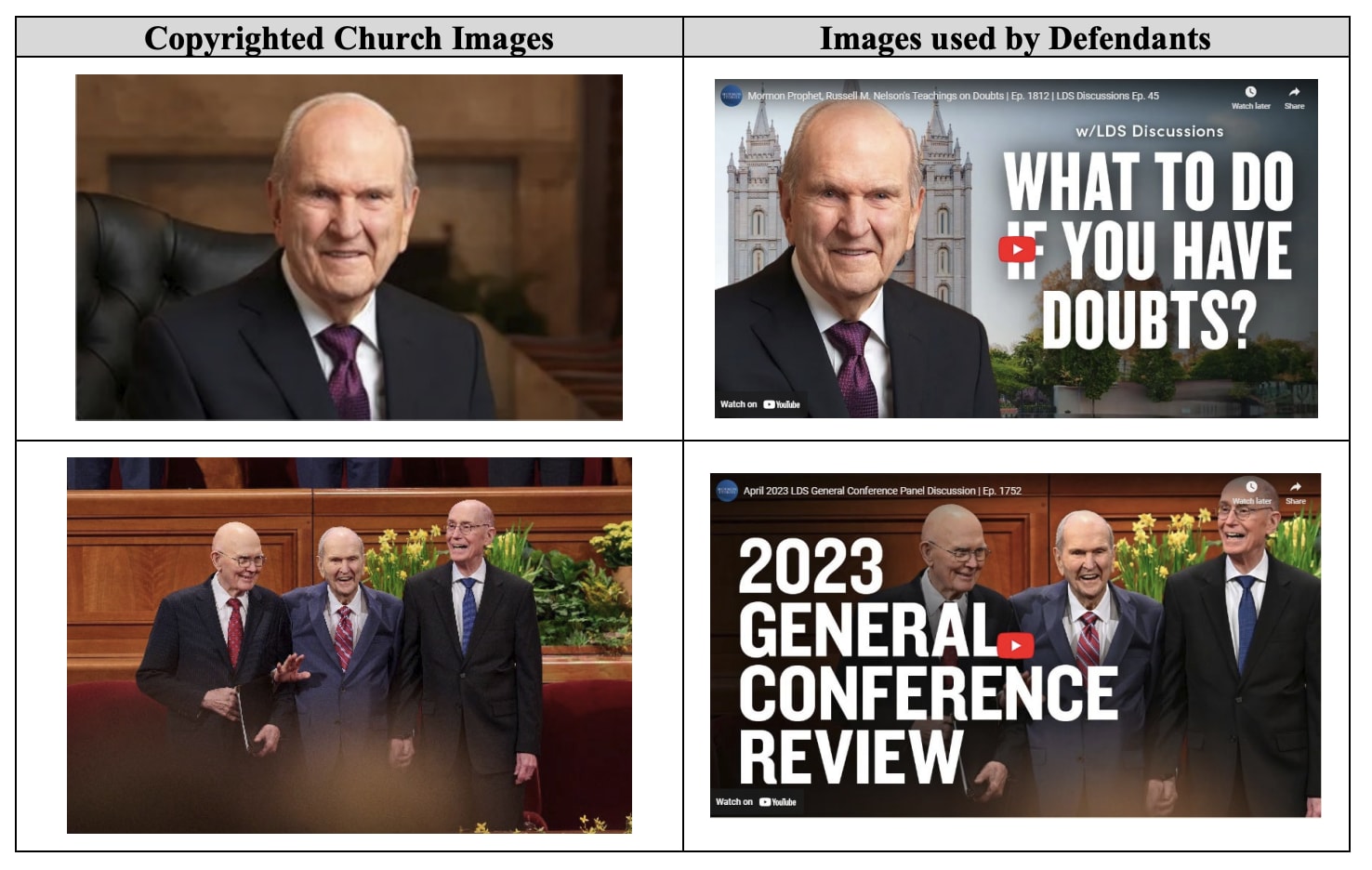
Just consider the copyright issues. The lawsuit included examples of official photos released by the Church that were later used in the thumbnails for Dehlin’s podcast videos:
Those seemed like perfectly normal cases of “fair use.”
The Church was also mad that Dehlin used the word “Mormon” at all… which was wildly ironic given that the LDS Church itself urged people to stop using the word because they didn’t want to be known that way to the point that even the famous Mormon Tabernacle Choir had been renamed the Tabernacle Choir at Temple Square.) And yet here they were telling the court that it was their word and not anyone else’s… and they had the paperwork from the U.S. Patent and Trademark Office to back it up.
This is all, they said, deeply damaging to the billion-dollar religious organization:
Unless these acts of Mormon Stories are restrained by this Court, they will continue, and they will continue to cause irreparable injury to Plaintiffs and to the public, for which there is no adequate remedy at law.
May we all strive to have that kind of influence. The Mormon Church was seriously arguing that Dehlin’s perfectly defensible use of their language and imagery might topple the entire damn religion. As if one man could destroy all of Salt Lake City through the power of… a podcast.
The lawsuit asked the court to stop Dehlin from using any logos or imagery that was “confusingly similar” to the LDS Church’s, and they wanted a jury trial.
Dehlin issued some informal responses to all this at the time, saying that he’s “been using the Mormon Stories name for my podcast for more than 20 years without any objection from the Church” and that he made plenty of changes at the request of LDS Church lawyers. But he added that it was “unreasonable” to demand anything beyond that:
… We didn’t feel any disclaimer was required, but in the spirit of cooperation we adopted one in our podcast description. The Church wanted us to make the disclaimer more prominent so it was essentially the primary thing anyone sees in our branding which we believe is unreasonable. We don’t want our primary message to be about what we are NOT. We have operated for a long time promoting who and what we are…
He said he was surprised by the lawsuit “given how cooperative we have been.” (There is a fund for supporters who want to contribute to the podcast’s legal defense.)
The LDS Church insisted it wasn’t going after Dehlin for what he says, only for the way he’s marketing his show, but there’s just no jury on Earth who would buy that excuse. They argued:
People are free to express support for or criticism of the Church and its teachings. This case does not concern the content of the podcast.
Uh-huh. Sure it doesn’t….
There’s a far stronger case that the Broadway musical “The Book of Mormon” might confuse outsiders who don’t know any better, but the Church didn’t fight that battle in court. If anything, they used it to their advantage. Did the Church sue Hulu over “The Secret Lives of Mormon Wives”? Not a chance. Even though that suggested a window into, well, the secret lives of Mormon wives.
In my mind, it was truly amazing this is how the LDS Church was wasting its time and money. Pope Leo is fighting fascism while the Mormon Church is fighting a podcaster.
And now, Dehlin’s team has filed its official response in court, calling on the judge to dismiss the entire case. While many of the arguments are ones I’ve written about above, it’s worth noting how Dehlin defends himself.
When it comes to the use of the word “Mormon” and whether it constitutes trademark infringement, the LDS Church has to show there’s no artistic/editorial relevance and that Dehlin is trying to mislead people.
It’s not hard to rebut any of that:
… the word “Mormon” has a strong cultural significance far beyond any alleged source-identifying function claimed by the Church; it is used as a ubiquitous and descriptive reference to Mormonism writ large, including the history, traditions, culture, and people within Mormonism beyond just the Church itself… Indeed, the Church itself has publicly declared that “Mormon” is only a “nickname” for members of the Church and is “correctly used in proper names” or “when used as an adjective.”
…
Defendants’ MORMON STORIES podcast series uses the term “Mormon” in the title to signal the subject matter of the series—stories about Mormonism, Mormon culture, Mormon history, and Mormon experiences. There is nothing in the title of the podcast that is overtly misleading or deceptive—indeed, it accurately and creatively describes the content that the listener can anticipate engaging with.
Dehlin also points out the LDS Church waited 20 years before filing this lawsuit—suggesting they waited until the podcast became incredibly popular to try to silence it rather than go after it the moment they found out about its name. It’s not like they only learned about the podcast this year! In fact, he says, it’s “impossible for the Church to claim it was not aware of Defendants’ use of MORMON STORIES for more than a decade before filing the present action.”
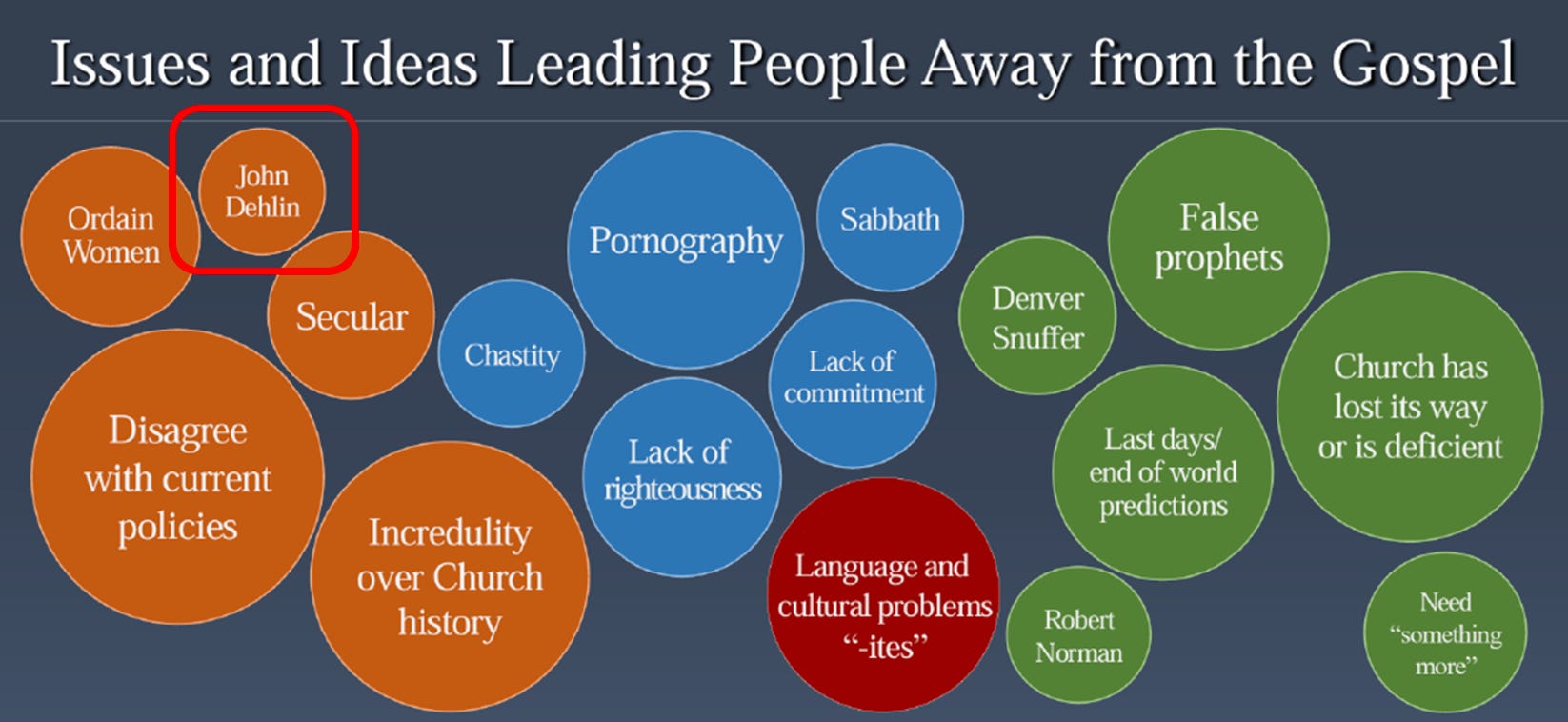
In a separate filing, responding to the LDS Church’s lawsuit line by line, Dehlin goes into more depth about the podcast and his own history with the Mormon Church. My favorite bit there may be the inclusion of a chart from December of 2015 in which the Church’s Quorum of the Twelve Apostles—a second-tier group of leaders—held a meeting to discuss why people were leaving the LDS Church… and included Dehlin as a reason for that.
Dehlin says that chart alone is “effectively an admission that his MORMON STORIES podcast did not create confusion about the podcast being affiliated with or sponsored by the Church.”
Not only that, but in 2010, the LDS Church trademarked its own “Book of Mormon Stories” podcast and told the United States Patent & Trademark Office that no other podcasts with similar names “would create a likelihood of confusion with the Church’s podcast name.”
Elsewhere in the response, he argues the LDS Church has no ownership of the blue color or a generic “light rays” design.
Dehlin adds in a press release that he made changes to appease the LDS Church, but they made no compromises for him, and the lawsuit came as a shock:
According to today’s filing, Mormon Stories Podcast and the Open Stories Foundation have included disclaimers indicating its clear independence from The LDS Church since its founding. Mormon Stories’ use of the color blue and “rays” in its branding began well over a decade ago, and did not begin around 2022 as suggested by the Church’s claims. But, to avoid expensive litigation, Mormon Stories and the Open Stories Foundation engaged in months of mediation after first being contacted by The Church in late 2025, and agreed to numerous changes requested by Church representatives, including modifications to branding, disclaimers, logos, and imagery.
“We made substantial changes in good faith because we believed reasonable compromise could resolve this matter,” Dehlin said. “We were surprised to learn that despite accepting most of The Church’s requested changes, litigation would proceed. It feels like we were the only ones making compromises, and The Church took an all-or-nothing, one-sided approach to mediation, which included unreasonable demands. It is also very disappointing that The Church chose to publicly mischaracterize what happened in mediation.”
While the court will eventually have to weigh in, none of this is a good look for the Mormon Church. They’re not really trying to protect their “brand” at all. They’re just trying to put obstacles in the path of someone who has helped countless people leave the Church. Rather than addressing the criticisms people on Dehlin’s show make, they’d rather turn off the microphone by forcing Dehlin to fight an expensive legal battle.
Dehlin is fighting back by making several points:
The Church’s own documents—noting they’ve known about him for a long time—undermine their argument that their only concern is trademark violations.
The 20-year delay suggests there was never really any confusion about what Dehlin was up to.
The idea that the Church needs to protect the word “Mormon” is ridiculous given that Church leaders have openly distanced themselves from the word.
The word “Mormon” is a generic word that’s bigger than just the religious institution. You can’t copyright it any more than a church can copyright “Christian.”
He has a First Amendment right to criticize the Church.
Overall, though, this is how you know his show makes a positive difference in people’s lives. It shows them their lives can be fulfilling and wonderful and guilt-free outside the bubble of Mormonism.
If this is how the LDS Church treats a former insider who asks questions and builds community, imagine what it signals to current members who are quietly doubting. If you become too effective at articulating those doubts, the institution won’t just argue with you; it’ll try to silence you.
By picking this fight, the Mormon Church is only confirming the criticisms they’re so desperate to suppress.
(Portions of this article were published earlier)
Please share this post on Reddit, Facebook, or the godawful X/Bird app.
This newsletter is free and goes out to over 24,000 subscribers, but it’s only able to sustain itself due to the support I receive from a small percentage of regular readers. Would you please consider becoming one of those supporters? You can subscribe via Patreon or the Subscribe button below! You can also make one-time donations through Venmo or PayPal.
The latest lie coming from Christian pseudo-historian David Barton and his equally ignorant son Tim Barton is one that’s easy to fact-check, yet a very gullible religious audience ate it up without question.
A quick refresher: Barton has made a career out of twisting and distorting the words of the Founding Fathers and the Bible in defense of Christian Nationalism, homophobia, and bigotry. He’s such an egregious Christian liar that he claimed to have an earned Ph.D. that was later revealed to be a hoax. And he once wrote a book about Thomas Jefferson that was so full of misinformation that his Christian publisherspulled the book from the shelves, saying, “There were historical details—matters of fact, not matters of opinion, that were not supported at all.” (The book was ironically titled The Jefferson Lies.)
And yet conservative Christians and Republican politicians still cite him as an authoritative source of information to the point that Barton is literally a consultant for the Texas Board of Education. Conservatives all know the sort of people who take them seriously aren’t really interested in honesty. They just want someone to say, with total confidence, whatever they all wish was true. Barton has capitalized on that by tying together his religious fantasies and his ignorance of U.S. history.
That’s what he and his son were doing this past April at World Outreach Church in Murfreesboro, Tennessee.
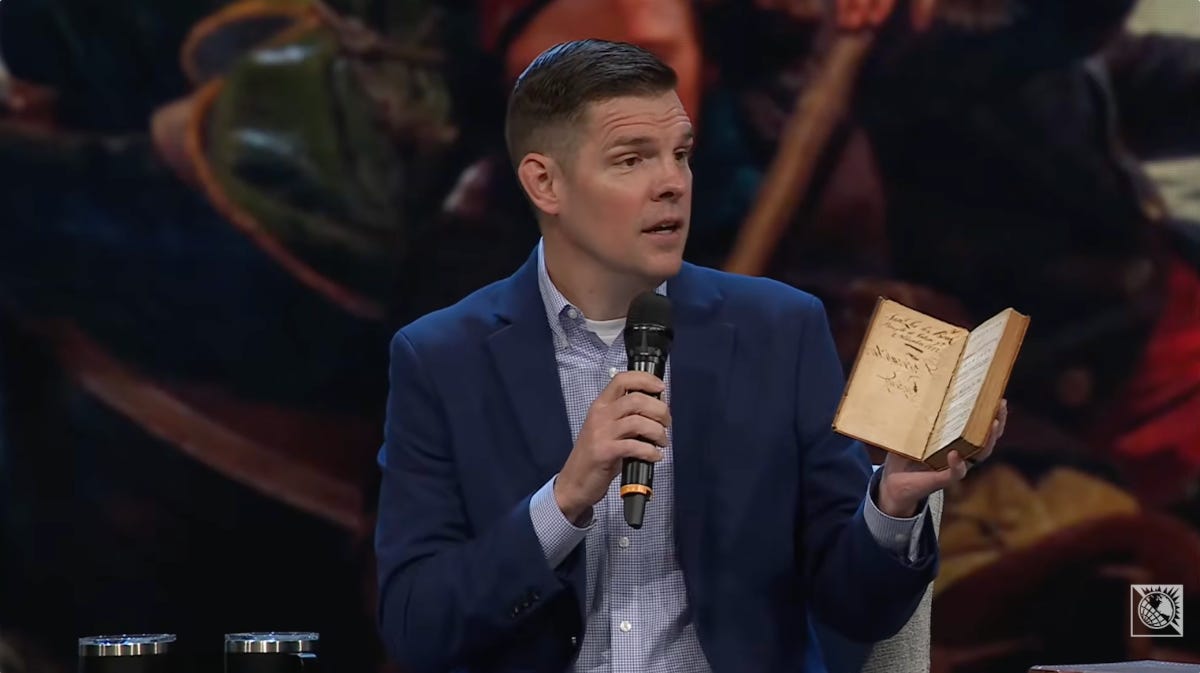
Tim Barton opening a book he never read (screenshot via YouTube)
Midway through their interview with the church’s pastor, Tim Barton claimed that Americans owed a debt of gratitude to preacher John Wise, who allegedly inspired the Declaration of Independence. To make his point, Tim held up a book containing two of Wise’s sermons and explained the connection to the Founders:
This is a book with two sermons from John Wise. These sermons were actually preached back in the early 1700s, but this was reprinted in 1772…
… In one of these two sermons, John Wise, and I quote, says, “All men are created equal and endowed by their Creator with certain inalienable rights.” [Lengthy pause]
That’s in the Declaration!
This is also where they got the idea he taught that God’s preferred form of government was the consent of the governed. He taught—and this is in these sermons, these two sermons—he taught that taxation without representation is tyranny.
Those are all things that show up in the Declaration.
This was reprinted by the Founding Fathers…
There’s just one problem with that link: The material Tim Barton was quoting never appears in those sermons. He flat-out lied about that.
You can read the “sermons” here. The part he literally quoted? It’s not in there. There are references to basic concepts of democracy but it’s not like those were original thoughts either. They were ideas that had been floating around at the time.
Warren Throckmorton, who brought this to my attention and who’s written extensively about the Bartons and their lies, pointed out that it’s far more likely both Wise and Jefferson were influenced by someone else: Enlightenment writer Samuel Pufendorf.
The more general claim that ministers and sermons directly contributed to what Jefferson wrote in the Declaration of Independence is not supported by an appeal to John Wise. Whereas Wise’s books may have encouraged some readers to integrate Enlightenment views of natural rights with Christian theology, there is no evidence that Jefferson owned or read Wise’s books. It seems more plausible that Jefferson was influenced by Pufendorf independent of Wise. Furthermore, Jefferson’s own testimony points to other influences.
There’s a simple way to counter this, of course. The Bartons could just show us where in Wise’s sermons he ever said—and I quote—”All men are created equal and endowed by their Creator with certain inalienable rights.” They won’t do that because they have a longstanding habit of never opening the books they cite.
Why would they lie about this? Because they know their audience won’t challenge them. They know the pastor isn’t going to follow up and ask, “Wait, what page is that quote on?” They also have a larger purpose in mind. Throckmorton writes:
Christian nationalists want their audiences to believe the US is a nation inspired and created by Christian influences alone. They seem to feel this gives them an advantage in political battles now. If the nation was inspired by Christian principles at the founding, the reasoning goes, then surely it ought to be ruled by Christian principles (as they define them) now.
He’s absolutely right about that. It’s obvious why Tim Barton was saying this: He wanted to make the point that the Founding Fathers took their best ideas from Christianity, furthering the idea that we live in a “Christian nation.”
That’s why these aren’t honest mistakes. It’s not like two researchers overlooked a footnote or misremembered a quotation. The younger Barton held up this book in front of a church audience and attributed to it a specific sentence that does not exist. It’s the same move pastors make whenever they insist God’s commands are perfectly in line with Republican cruelty. They know damn well that the members of their congregation are never going to dig into their lies.
But it’s not like this is the first time the Bartons have done this. That’s why no actual historians take them seriously. They’re con artists. Their goal isn’t to understand the Founding Fathers; it’s to rewrite history in a way that elevates conservative Christian goals. Every lie they tell serves the same purpose: convincing Republicans that their political agenda is the natural continuation of America’s original mission. They have their conclusion figured out before they ever dig into the evidence.
The Bartons know what every professional liar has already figured out: Confident lies are way more persuasive than verifiable truths. It’s what they’ve built their careers on.
And the problem with that is that these lies are used to justify real policy changes. If you can convince Christians that America was founded exclusively on Christian principles, you can argue that Christianity deserves special authority today. Hell, you can argue that children need to be taught Christianity in school for historical reasons, not religious ones. That’s what this is all about. If you can rewrite the past convincingly enough, you can reshape the future. And far too many white evangelicals love being lied to.
Please share this post on Reddit, Facebook, or the godawful X/Bird app.