


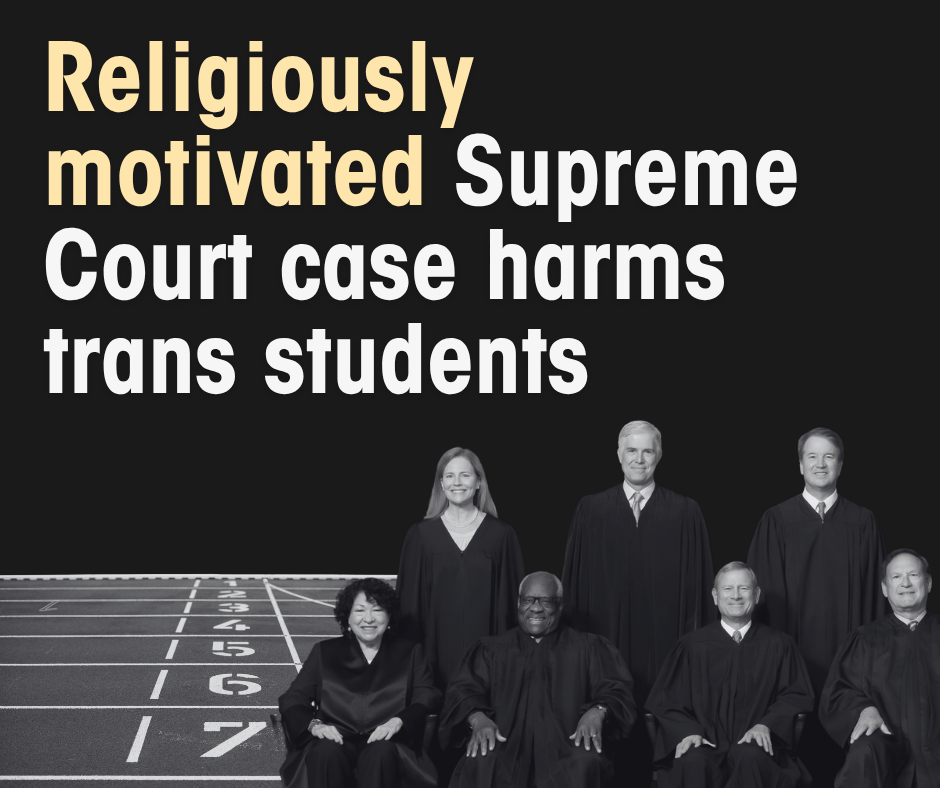
Becky Pepper-Jackson has spent years running alongside her classmates while her legal challenge worked its way through the courts. Today, the U.S. Supreme Court ruled that states may bar her and other transgender girls from competing on girls’ sports teams.
The U.S. Supreme Court’s ruling today against transgender students in two consolidated cases will cause immediate and lasting harm to vulnerable children across the country.
The cases, Little v. Hecox and West Virginia v. B.P.J., challenged Idaho and West Virginia laws barring transgender students from girls’ and women’s sports teams in public schools and colleges. In upholding the bans, the court accepted sweeping generalizations about sex and gender while disregarding the real-world impact on individual students.
“This decision confirms what was evident at oral argument: These laws are not about fairness in sports, but about enforcing a particular religious ideology through state power,” says Deputy Legal Director Liz Cavell. “Public schools should be places of inclusion and equal opportunity, not testing grounds for religious dogma that harms children.”
FFRF notes that both cases were advanced with the direct involvement of Alliance Defending Freedom, a Christian nationalist legal organization that has made restricting LGBTQ+ rights a central part of its mission. ADF attorneys represented and supported Idaho and West Virginia throughout the litigation, underscoring that these cases are part of a broader religious campaign rather than a genuine effort to regulate athletics.
In its decision, the court adopted the states’ framing that athletic eligibility must be determined solely by sex assigned at birth, rejecting arguments grounded in medical evidence. The majority minimized the relevance of gender identity and dismissed evidence showing that many transgender girls, particularly those who have undergone estrogen-driven puberty, do not possess the athletic advantages the laws purport to address.
FFRF warns that although the court framed its analysis as one of statutory interpretation and equal protection, the ruling will inevitably be embraced by religious organizations that have spent years seeking to codify their theological views about sex and gender into civil law. The decision removes an important constitutional safeguard for transgender students while advancing a legal agenda long championed by religious-right advocacy groups.
Justice Sonia Sotomayor, concurring in part and dissenting in part, criticized the majority for cutting off factual development before lower courts could fully evaluate whether transgender girls like Becky Pepper-Jackson actually undermine the states’ asserted interests. Joined by Justices Elena Kagan and Ketanji Brown Jackson in her dissent on the Equal Protection Clause issue, Sotomayor wrote: “These circumstances demand exercising judicial restraint, not rushing to answer conclusively difficult questions without sufficient evidentiary development.”
Becky Pepper-Jackson is precisely the kind of student Sotomayor said deserved that opportunity. Now 15 years old, the West Virginia transgender girl was preparing to enter middle school when the state enacted its ban in 2021. Becky has lived as a girl for years and has undergone an estrogen-driven puberty. She was allowed to compete on her school’s cross-country and track teams while her case was pending, participation that her doctors say was vital to her well-being.
Supporters of transgender athlete bans often argue the laws are necessary to “save women’s sports.” Yet lawmakers have routinely failed to identify instances of transgender girls dominating K–12 athletics in their states. The harm to transgender youth, by contrast, is well documented. Transgender adolescents face significantly elevated risks of depression and suicide, risks that are reduced when they are supported and included in school communities. For most students, school sports are about participation, belonging and personal growth, not podiums or scholarships.
FFRF notes that support for restrictions on LGBTQ+ rights is highest among the country’s most religious populations, while religiously unaffiliated Americans consistently express the strongest support for LGBTQ+ equality. Acceptance drops sharply among evangelical Protestants and frequent churchgoers. Religious beliefs have historically been used to justify discriminatory laws, from bans on interracial marriage to the criminalization of same-sex relationships, and now reappear in legislation targeting transgender youth.
“Given the court’s recent record, it is sadly not surprising to see religious ideology once again outweigh the rights and well-being of students,” says FFRF Co-President Annie Laurie Gaylor. “When discrimination is treated as reasonable and religious motivation is brushed aside as legally irrelevant, vulnerable children pay the price.”
FFRF supports the full equality and dignity of transgender people and opposes the use of government power to deny a vulnerable minority equal participation in public life. The Constitution requires government neutrality on matters of religion.
Today’s ruling will have far-reaching negative consequences for transgender students nationwide, signaling that laws rooted in religiously informed views of sex and gender may now withstand constitutional scrutiny. But FFRF remains committed to defending the constitutional rights and dignity of all students, and will continue fighting to ensure that public schools remain places of equality, inclusion and freedom from religiously driven discrimination.
The Freedom From Religion Foundation is a U.S.-based nonprofit dedicated to defending the constitutional principle of separation between state and church and educating the public on matters relating to nontheism. With more than 41,000 members, FFRF is the largest association of freethinkers (atheists, agnostics and humanists) in North America. For more information, visit ffrf.org.
The post Religiously motivated Supreme Court ruling harms transgender students appeared first on Freedom From Religion Foundation.







Leave a Comment
You must be logged in to post a comment.